
NCC Fire & Ophir Hill Consolidation Information
CONSOLIDATION: NEVADA COUNTY CONSOLIDATED FIRE DISTRICT AND THE OPHIR HILL FIRE DISTRICT
This newly reorganized district aims to leverage the strengths of the two entities, creating a more efficient and effective operation. Key components include:
- INTEGRATION OF RESOURCES – Combining human, financial and technological resources to optimize productivity and reduce any redundancies.
- UNIFIED STRATEGY – Developing a cohesive strategic plan that aligns with the goals and objectives of the district.
- ENHANCED SERVICE DELIVERY - Improving service delivery through streamlined processes and better resource allocation.
- INNOVATION AND DEVELOPMENT – Fostering a culture of innovation to drive development and maintain a competitive edge in the delivery of emergency services.
- STAKEHOLDER ENGAGEMENT – Enhancing stakeholder engagement to ensure transparency, build trust, and foster long-term relationships.
CONSOLIDATION GOALS
The consolidation intends to maintain and enhance existing levels of service and staffing of the involved fire protection districts by eliminating duplication of services and maximizing existing revenue sources to the fullest extent.
The consolidation will ensure equitable access to resources, including raising awareness about the Special Districts Response Fund (SDFR Fund) among underfunded districts and implementing strategies to ensure we receive the necessary support.
Alternatively, this consolidation can be accomplished in one action: Nevada County Consolidated Fire annexing and the current Ophir Hill service area.
Each Fire Board has adopted resolutions authorizing the proposed consolidation to proceed before the Local Agency Formation Commission (LAFCO). Once annexation and dissolution have been approved, the resulting entity will adopt a resolution confirming Nevada County Consolidated Fire District as the official entity.
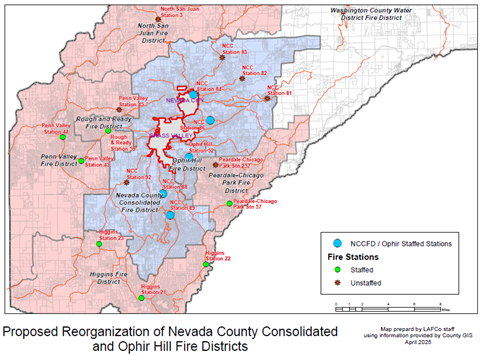
MAP OF THE NEW DISTRICT
The consolidation of the two fire districts will cover the service area shown in the figure, excluding the NCCFD Sphere of Influence areas. This map depicts five staffed fire stations as per the reorganization plan.
RESPONSE PROCEDURES
Nevada County Consolidated Fire and Ophir Hill Fire Protection District utilize a joint response plan that was developed under the concept of operations "Closest Resource Response." The response plans identify response areas based on staffed fire stations to achieve the goal of providing a six-minute response time average to emergency incidents.
The joint operating response plan further provides for move-up and cover assignments during emergency incidents, allowing the departments to continue to provide coverage for the response areas should multiple incidents occur at the same time. The new District will combined into one operational area, Battalion 8, as shown in the following figure. Battalion 8 will be staffed by a battalion chief who will oversee the operations for the five (5) staffed stations.
COMBINED ORGANIZED STRUCTURE
Managing personnel through a consolidated model will provide efficiency, standardization, and enhance services. Consistency, fairness, safety, and opportunities for personal and professional growth are key values that will be closely adhered to.
Operational resources and service levels will also ensure an appropriate balance of administrative and operational staff to achieve successful outcomes. These key administrative and logistical support positions are critical in maintaining an efficient and effective fire organization. Comparing positions across two fire agencies has revealed several opportunities for sharing and combining positions to improve overall effectiveness. Evaluating job descriptions, work schedules, compensation packages, and the leveraging scale of the economy of personnel will provide efficiencies, increased service levels, and opportunities to reduce expenses through cost avoidance through duplication.
Combining all human assets into one organizational structure provides numerous benefits, including balanced resources, cost efficiency, response standardization, and improved overall service delivery.
The consolidated organization intends to reassign positions best to meet the operational needs of the entire service area, add new positions to improve the level of service to the combined communities, significantly enhancing the emergency response capabilities within the service area, ensuring that critical incidents are managed more effectively and efficiently.
ADMINISTRATIVE STAFF
Merging the administrative staff from both districts yields benefits because the current administrative staff possesses years of institutional knowledge and a precise understanding of the various systems that are currently in place. After consolidating, staff will be able to hyperfocus on more specific aspects and eliminate overlapping redundancies. By combining staff and processes, we will increase the effectiveness and efficiency through streamlined tasks that avoid duplication of support staff functions.
HISTORY OF NEVADA COUNTY CONSOLIDATED FIRE DISTRICT
Nevada County Consolidated Fire District (NCCFD) is the product of merging smaller fire districts into one entity. Notable dates include the following:
July 1991 - Gold Flat and Bullion Fire Districts consolidated into one District, forming the Nevada County Consolidated Fire District. It consisted of six fire stations, covered approximately fifty-six square miles, had a population of approximately 17,000, and responded to approximately 850 calls per year. The new Fire District included a combination of paid and paid-call staff. The new seven-member Board of Directors has hired a career Fire Chief from outside of the area. Staff included a full-time Fire Marshal, six full-time Firefighters, one Administrative Assistant, one Financial Officer, and 40 volunteer Firefighters. The career Firefighters provided an initial response twelve hours per day, seven days per week, from two fire stations.
January 1993 - NCCFD completed consolidation with the Alta-Oaks-Sunset Fire District (AOS). AOS covered approximately nine square miles, had a population of approximately 3,000, and responded to 400 calls per year from its one fire station. It was a combination department with one full-time employee (the Chief), a Firefighter trainee, a volunteer Assistant Chief, and 12 volunteer Firefighters.
January 1998 - NCCFD consolidated with Watt Park Fire Protection District (WPFPD). Established in 1958, WPFPD provided emergency services to approximately 2,500 people from two fire stations. There were four full-time employees and fifteen volunteer Firefighters who responded to over 318 calls in 1996.
October 2003 - NCCFD consolidated with 49er Fire Protection District (49er). Established in 1956 as a volunteer Fire Department. 49er Fire served the areas of Cement Hill, Wet Hill, Newtown Road, and the areas around Nevada City. In 1962, the Volunteer Fire Department became a Special District, which allowed for the collection of taxes for fire protection. It became known as the 49er Fire Protection District ("49er FPD" or "49er"). In 1973, the area known as Cascade Shores and Lake Park Estates was annexed into 49er FPD. Due to the passage of Proposition 13, 49er FPD received no new revenues from the annexation. Each merger increased the level of service for their community and set the foundation for the current success.
July 2026 - Ophir Hill Fire Protection District consolidates with NCCFD. Established in 1956, Ophir Hill Fire Protection District proudly served the Cedar Ridge community with a legacy built on dedication, professionalism and and unwavering commitment to public safety. The name is derived from the original fire station that was at the base of Ophir Hill in the Union Hill area. The Volunteer Fire Department became a Fire Protection District in 1963. The first fire engine the department put in service was a 1940 Dodge purchased for one dollar from the Empire Mine upon its closure in 1956. The District has transitioned over the years from an all-volunteer agency to a combination of full-time career and paid call agency. This consolidation reflected a shared vision for the future - one that preserved the past traditions while evolving to meet the dynamic changes in the fire service.
Current facilities and equipment include:
Station 81 – 16528 Pasquale Road, Nevada City. Located near the intersection of Pasquale Road and Banner Quaker Hill Road in Cascade Shores. This station is unstaffed and houses one Fire Engine.
Station 82 – 18969 Scotts Flatt Road, Nevada City. Located at Hwy 20 and Scotts Flat Road. This station is unstaffed.
Station 84 – 640 Coyote Street, Nevada City. Located at Highway 20 and Coyote Street. The station serves as NCCFD's administrative headquarters. The station is staffed with 4 personnel each day (one Battalion Chief, one Company Officer, and two Firefighters). Station 84 houses one Engine, one Water Tender, one UTV, one Light Rescue, and one Command Vehicle.
Station 86 – 12337 Banner Lava Cap Road, Nevada City. Located on Banner Lava Cap Road and Valley View Road. This station is staffed with two personnel each day (one Company Officer and one Firefighter). Station 86 houses one Engine and one Squad with snowplow capabilities.
Station 88 – 14400 Golden Star Road, Grass Valley. Located near Hwy 49 and Allison Ranch Road. This station is staffed with two personnel each day (one Company Officer and one Firefighter). Station 88 houses one Engine, one Water Tender, and one Cal OES type VI.
Station 89 – 11883 Tammy Way, Grass Valley. Located next to the Alta Sierra County Club. This station is staffed with two personnel each day (one Company Officer and one Firefighter). Station 89 houses one Engine, one Reserve Engine, and one Wildland Type III Engine.
Station 91 – 11329 McCourtney Road, Grass Valley. Located across from the Nevada County Fairgrounds. The station serves as the primary meeting place for all NCCFD board and special meetings. This site also serves as a substation for the Nevada County Sheriff's Office and headquarters for their Search and Rescue Team.
Station 92 - 14811 McCourtney Road, Grass Valley. Located across from the Nevada County Transfer Station. This location is staffed with certified mechanics on Monday-Friday and serves as the main repair facility for all District vehicles.
Station 85 (formerly 52) - 12668 Colfax Highway, located in Cedar Ridge, this station is staffed with two personnel each day and covers the Cedar Ridge, Union Hill, and Rattlesnake Road areas.
Equipment - Five Type I Fire Engines, one Type II Fire Engine, one Type III Fire Engine, one Cal OES Type VI Engine, two Type VI Engines, two Water Tenders, two repair service trucks, and nine command/utility vehicles.